 English
 русский
 Español

A parts counter conversation usually starts the same way. The driver says the engine is "making a noise near the front", the technician writes "water pump or tensioner?" on the job card, and the parts desk opens a catalog that uses neither phrase. The distance between workshop language and catalog language is where most wrong orders begin — and why a plain list of auto engine parts names is useful only when every name is tied to a position, a model year and a number.
The conclusion first: nearly every engine part name you will be asked to supply belongs to one of six families — block and rotating assembly, cylinder head and valvetrain, lubrication, cooling, air and fuel, and engine management hardware.
A name alone is not orderable. It becomes orderable when you add three facts: side or position (left/right, upper/lower), the exact engine code or model year, and an OEM number the supplier can cross-reference. Skip any one of those and the return rate climbs.
Content
- 1 The Six Families That Hold Almost Every Engine Part Name
- 2 What the Familiar Names Actually Describe
- 3 Name Versus Number: Where Fit Is Actually Decided
- 4 Where Engine Part Requests Actually Go Wrong
- 5 How Engine Part Demand Splits Across Systems
- 6 A Five-Step Ordering Flow That Prevents Repeat Trips
- 7 Maintenance and Compliance Details Worth Checking
The Six Families That Hold Almost Every Engine Part Name
Sorting names into families first makes a supplier catalog readable in seconds. The six groups below cover the requests that come up most often at the counter, from a single seal to a complete turbocharger.
1. Block and rotating assembly
Cylinder block, crankshaft, pistons, piston rings, connecting rods, main and rod bearings, flywheel. These are matched by bore size and journal grade, never by name alone.
2. Cylinder head and valvetrain
Cylinder head, head gasket, valve cover, camshaft, valves, lifters, timing chain or belt, tensioner and guides.
3. Lubrication
Oil pan, oil pump, pickup tube, oil cooler, filter housing, dipstick and the seals that keep the circuit closed.
4. Cooling
Water pump (mechanical or electric), thermostat, radiator, coolant hoses, expansion tank and cooling fan.
5. Air and fuel
Air filter, throttle body, intake manifold, fuel injectors, fuel rail and turbocharger.
6. Management and sealing
Knock, cam and crank position sensors, ignition coils, spark plugs, plus the gaskets and O-rings that seal every joint.
What the Familiar Names Actually Describe
Rotating parts: same name, different grade
"Piston" tells you almost nothing. A piston is defined by bore diameter, compression height and ring groove width; a connecting rod by center-to-center length and big-end journal grade. Modern rod bolts are usually torque-to-yield, so they are replaced rather than reused — a detail that changes the quote more than the part name does.
Valvetrain and sealing: where hundredths of a millimetre matter
A cylinder head gasket is selected by bore, thickness and construction. Multi-layer steel (MLS) gaskets are the norm on turbocharged engines, and a 0.1 mm difference in compressed thickness shifts compression ratio and can raise a fault code on a sensitive combustion strategy. A valve cover often carries an integrated PCV diaphragm, so the correct name is "valve cover assembly", not simply "gasket".
Cooling: the name hides a drive type
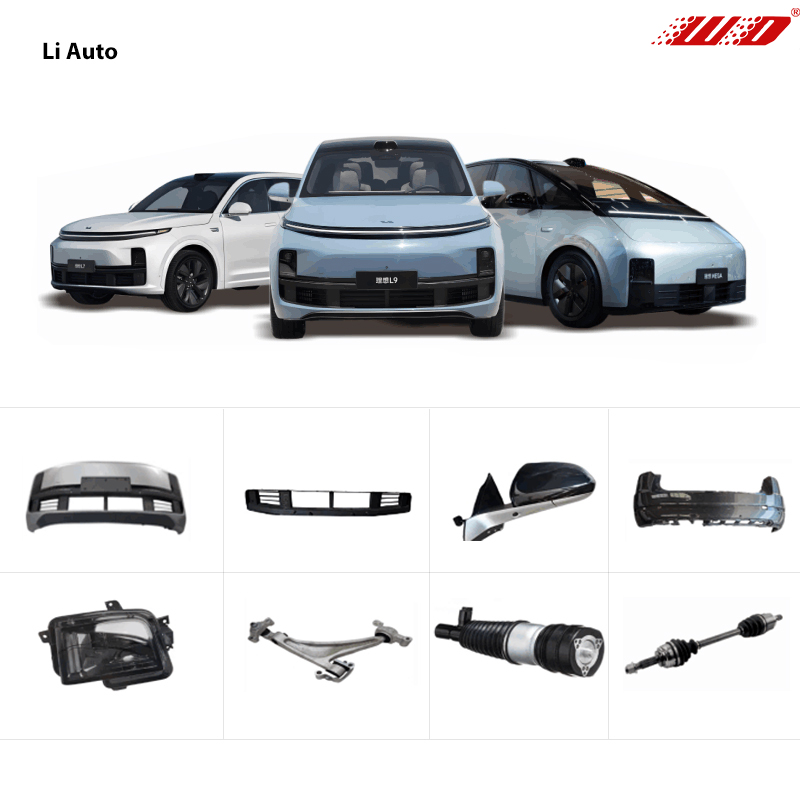
On range-extender and battery-electric platforms, the "water pump" is frequently an electrically driven unit with a connector, a control strategy and a specific flow rate, not a belt-driven impeller. Ordering the mechanical version for a vehicle built around an electric pump produces a unit that physically fits and functionally does not work. In catalogs organized by model — for example the Li Auto L6 to L9 engine parts group — the water pump sits beside the oil cooler, valve cover and turbocharger because those are the parts most often replaced together.
 Li Auto L6–L9 Water Pump 1001447Coolant pump for Li Auto L6–L9 engine temperature control; confirm it matches the vehicle’s pump type and part number 1001447.View Product →
Timing drive: chain, belt or kit
"Timing chain" is a wear item only in the company of its tensioner and guides. Chain stretch shows up first as a cold-start rattle and a cam-to-crank correlation code, and replacing the chain without the tensioner usually brings the noise back within a season. A chain kit is priced as one line item precisely because the individual names are almost never sold separately in practice.
Name Versus Number: Where Fit Is Actually Decided
The left column below is what a workshop says. The middle column is what a catalog will accept. The right column is what decides whether the part goes on the car or back in the box.
Where Engine Part Requests Actually Go Wrong
Return logs from parts counters follow a repeating pattern. Position and year mismatches dominate, and pure naming confusion is a smaller cause than most people assume — the name usually gets corrected at the counter, the position does not.
How Engine Part Demand Splits Across Systems
On Chinese-brand platforms — Li Auto, ZEEKR, VOYAH, Leapmotor and Geely models included — engine-related demand is not evenly spread. Hard powertrain parts still lead, but thermal management and electronics together take close to half of the volume because hybrid and electric platforms carry more pumps, sensors and control modules than a conventional engine bay.
A Five-Step Ordering Flow That Prevents Repeat Trips
A short, fixed sequence removes most of the risk described above. It works for a single gasket and for a pallet of turbochargers.
Step 1 — Name it twice. Record the workshop term and the catalog term side by side. If the two disagree, the catalog term wins.
Step 2 — Pin the vehicle. VIN, model year and trim. A "high configuration" headlamp and a base version are different parts on several of these platforms, and 21-model and 24-model ZEEKR 001 components are listed separately for good reason.
Step 3 — Match the number. Read the OEM number off the old part, or from a catalog entry that lists it. This is where a timing chain, for instance, is confirmed rather than guessed.
Li Auto L6–L9 Timing Chain 1001908Quiet-chain timing component for Li Auto L6–L9 engines; confirm the OEM number and listed specifications before matching it to the engine.View Product →
Step 4 — Check specification, not just shape. Gasket thickness, coolant chemistry, filter bypass rating and connector pin count all pass a visual check and still fail in service.
Step 5 — Confirm packaging and paperwork. Sealed packaging, batch or lot marking, and an invoice carrying the OEM number protect the warranty claim later.
Maintenance and Compliance Details Worth Checking
Two vehicles can accept the same part name and still reject the same part. These are the checks that separate a routine job from a comeback, and they pair naturally with a documented routine maintenance parts list kept at the counter.
- Coolant: confirm organic-acid chemistry and freeze point before topping up; mixing chemistries degrades seals and can clog a heater core. Electric pumps need vacuum fill to avoid trapped air.
- Head work: check deck flatness against the manufacturer limit (commonly around 0.05 mm), replace torque-to-yield bolts, and follow the angle-torque sequence exactly.
- Timing work: fit chain, tensioner and guides as a set, and check oil condition — chain wear tracks oil quality more closely than mileage.
- Filtration: match viscosity grade and OEM approval for oil, and verify the filter's bypass setting; a mismatched filter changes cold-start pressure.
- Traceability: buyers increasingly ask for quality-system evidence such as IATF 16949 alignment, batch records and country-of-origin labelling for customs clearance.
Consumables are the easiest place to lose control, because they are ordered in volume and rarely re-checked. A single oil filter line is worth confirming once and then locking into the system.
 Li Auto L6–L9 Engine Oil Filter 1001787Maintenance oil filter for Li Auto L6–L9 engines; confirm the consumable line and part number 1001787 before volume ordering.View Product →
The practical takeaway is straightforward. Learn the six families, then stop relying on the name as the identifier. A part becomes orderable when you can state its position, its model year or engine code, and its OEM number in the same breath — and when the person on the other side of the counter can confirm all three before the box is opened. That habit costs a minute at the desk and saves a week in returns.